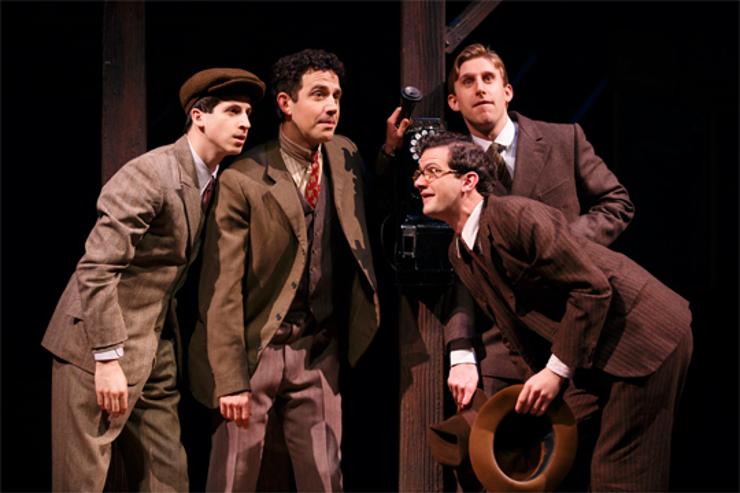
[printfriendly]
[yasr_overall_rating]
ACT ONE
Written and directed by James Lapine
From the Autobiography of Moss Hart
Through June 15, 2014
Vivian Beaumont Theatre
150 West 65th Street
(212-239-6200), www.ltc.org
By David NouNou
Adapting a legendary autobiography about the theatre is a risky and tricky matter, especially when the legend being discussed died in 1961, and writing about his early struggles of getting his foot in the theatrical door occurred in 1930. What makes it tricky is Act One came out in 1959, and it became a theatrical bible. People read books and didn’t go on Wikipedia to get instant summarization of a book or a man’s life. The man here is Moss Hart and he is legendary when you read his accomplishments as director, playwright, and screenwriter. He was a giant of his day. After all, he had just directed My Fair Lady, Broadway’s mega hit of 1956 and Camelot was to follow in 1960 just before his death. As a playwright, he co-wrote the Pulitzer Prize-winning You Can’t Take It With You and The Man Who Came To Dinner, both with George S. Kaufman. His screenplays consist of 1947’s Oscar-winning best picture Gentlemen’s Agreement and 1954’s A Star is Born, among others. The man was a prolific genius in every sense of the word.
But Act One isn’t about any of those historic events; it’s about his early childhood growing in the Bronx and Brooklyn in total poverty. His parents were Jewish immigrants from England, leading a dreary life, and the theatre was his only outlet. His Aunt Kate took him to a play and the bug bit. His life and passion became the theatre. He worked as a theatrical office boy, actor in the Catskills, wrote horrible plays that flopped and then wrote Once In A Lifetime and started collaboration with the celebrated master of the day, George S. Kaufman. The second act is all about the trials and tribulations of getting this play on its feet and to the Music Box Theatre on Broadway.
As I said earlier, writing about the theatre is a tricky matter, so the biggest challenge here is: Do modern audiences remember Moss Hart? They barely remember Rex Harrison and he was the actor who starred in My Fair Lady on Broadway and the movies. James Lapine has adapted the book into the play and pays reverential homage to the source by not omitting nary a single semicolon, which can be a good thing. Unfortunately, James Lapine the director didn’t take notes from his subject matter George S. Kaufman and delete a lot of his own written pages. For what actor, playwright, director didn’t grow up having a dreary life, being poor and had to work hard to get in the business? Ultimately, if they pay their dues, maybe, just maybe some do end up having the rags-to-riches story. Mr. Lapine had an interesting subject matter to deal with (Moss Hart) but unfortunately the book doesn’t deal with the interesting and later timeframe of his life to which modern audiences could relate. Mr. Lapine needed a Mr. Kaufman to edit a lot of the early unnecessary scenes and repetitious dialogue from Act II.
Having said all that and getting the storyline out of the way, there are a couple of hosannas on their way. Not since 1966 when the Beaumont opened and as a school project we had to go and discover the wonders of Lincoln Center, and the shows they were presenting, Danton’s Death and The Condemned of Altona (yes, I was a drama major) both dreary and bleak, but what struck me the most was the vastness of its stage. The revival of South Pacific tried to fill some of the vastness, but nothing compares to the set designed by Beowulf Boritt. The set is a revolving masterpiece that fills the entire stage and is very reminiscent of Oliver Smith’s sets. Mr. Smith, the premier set designer of his day, did the sets for My Fair Lady, Camelot, Hello Dolly, among many others. To see a show with awe-inspiring sets that is absolutely breathtaking; consisting of tenements, theatres, hotel rooms, offices and posh suites all on a revolving turntable are a vision to behold. Students studying theatrical design should see this show if for no other reason but the sheer magnificence of what Mr. Boritt has designed.
My other kudo goes to Tony Shalhoub, giving what might be his best stage performance to date. He plays three different roles succinctly: the older Moss Hart (who oversees the proceedings and how it all started); Moss’ father; as well as George S. Kaufman. His largest part is that of George S. Kaufman and he plays him to the hilt. Santino Fontana as the struggling young Moss Hart does an admirable and energetic job as the passionate and charming playwright. Then there is Andrea Martin, also playing three parts: Moss’ Aunt Kate with a cloying English accent; Frieda Fishbein, the agent, the name says it all; and finally Beatrice Kaufman, George’s socialite wife; that’s her best part, she plays her demurely and gives her a quiet touch of class.
The rest of the cast supported unevenly, the worst being Mimi Lieber as Moss’ mother, Lillie. At any given line, she had four accents going on in the same sentence: they consisted of an abominable English accent, Jewish, Bronx and Brooklynese. You never knew with which accent she would start, continue and then end the sentence. Where were Mr. Lapine, the director and the dialogue coach? Was the fake English accent really necessary? I don’t think the audience would have minded if Moss’ mother, father, and aunt, had spoken with a Jewish New York accent because at least that would have been relatable. There is a lot of good in Act One and Moss Hart was a provocative person to write about, but unfortunately it wasn’t the right time of his life that modern audiences could identify with and be riveted by in a long biographical stage drama. I still recommend seeing Act One for Beowulf Boritt’s astounding set and Tony Shalhoub’s remarkable performance.
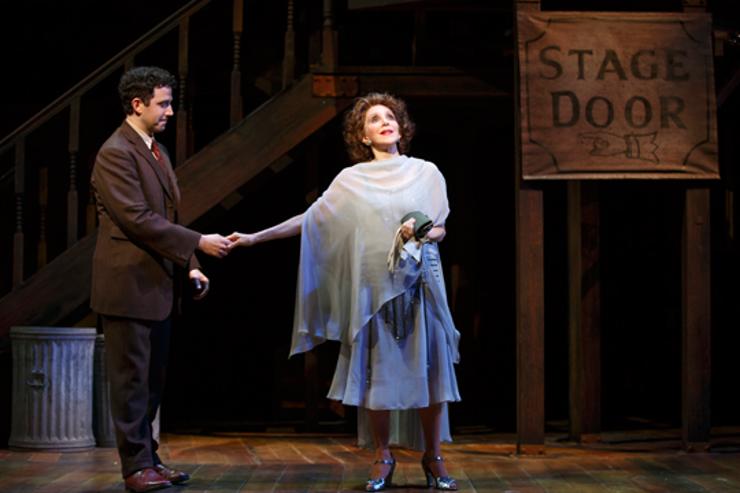
THE THESPIAN LIFE: Santino Fontana & Andrea Martin. Photo: Joan Marcus
Five Tony Nominations, including: Best Play, Best Actor – Tony Shalhoub, Costumes, Sound
WINNER: Beowulf Boritt, Best Set Designer
Edited by Scott Harrah
Published April 23, 2014
Reviewed at press performance on April 22, 2014
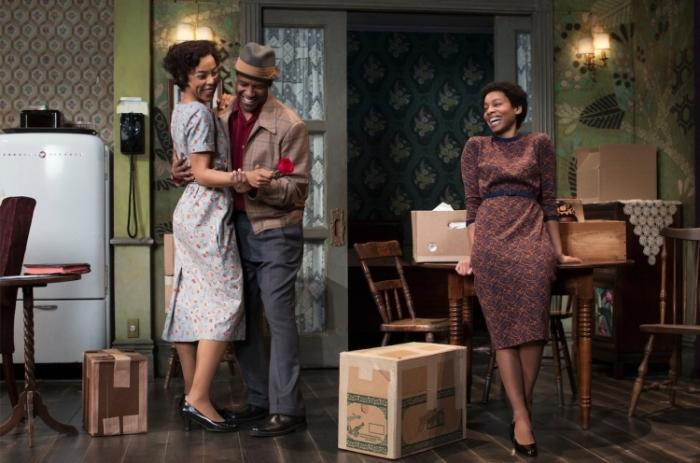
THE YOUNGERS: (left to right) Sophie Okonedo, Denzel Washington & Anika Noni Rose in
‘A Raisin in the Sun.’ Photo: Brigitte Lacombe
[printfriendly]

A RAISIN IN THE SUN
By Lorraine Hansberry
Directed by Kenny Leon
Ethel Barrymore Theatre
243 West 47th Street
(212-239-6200), www.raisinbroadway.com
By Scott Harrah
A Raisin in the Sun has been revived as a vehicle for Denzel Washington and originally for Diahann Carroll (who left the show during rehearsals), but it’s also important to see this because Lorraine Hansberry’s 1959 epic is one of the greatest American plays of all and certainly the greatest African-American drama ever, from both a structural and standpoint.
The late Ms. Hansberry’s saga of the Youngers, an African-American family in 1950s Chicago, groundbreaking when the show debuted on Broadway 55 years ago, and although parts of story are dated, the overall themes of a family grappling with adversity, broken dreams and
s struggle for independence are timeless.
The box-office draw here is certainly Mr. Washington, and he is more than effective (though a bit mature for the role) as Walter Lee, the chauffeur with dreams of one day owning liquor store. However, the role of Lena/Mama requires the largest acting ability in the show, LaTanya Richardson Jackson is marvelous as the bighearted matriarch with plans to use late husband’s $10,000 insurance money to buy a home in a better neighborhood (Ms. was a last-minute replacement for Ms. Carroll).
The central theme is the betterment of life for African Americans, but there is a universal about family and everyone’s unique dreams that gives the story mass appeal. While wants a nicer house, Walter yearns to use his father’s money to invest in a liquor store.
One might think a play originally produced more than 50 years ago would be dated, but A Raisin in the Sun is so epic and the dialogue so crisp that we overlook such outmoded things Joseph Asagai (Sean Patrick Thomas) discussing the benefits of living in Nigeria with
Walter Lee’s sister (Anoki Noni Rose), a fellow student who wants to marry her and her back to Nigeria his homeland. Mama wants Beneatha to use some of her father’s money to attend medical school.
Things are further complicated when Walter Lee’s wife, Ruth (Sophie Okonedo) discovers she pregnant but fears having another child will only bring the family more financial trouble.
Tensions build with each successive scene, and sensitive topics ranging from abortion to are integral to the plot.
Director Kenny Leon extracts great performances from the cast, but ultimately the weight of play is Mama’s responsibility, and Ms. Richardson Jackson is consistently dynamic and in the part, an amazing feat considering she was brought in just under the wire to the lead.
Before the show begins, the curtain at the Ethel Barrymore Theatre flashes stills of the late Hansberry and the Langston Hughes poem that inspired the title. It’s a fitting tribute the memory of Ms. Hansberry, a young woman who died of cancer at age 34 but left behind a story that is still so haunting and full of truth in the 21st century. For A Raisin in the Sun is as much a tale of families struggling and managing to stay together through adversity as it a chronicle of the African-American experience, so it is a story to which all Americans, of race or ethnicity, can relate.
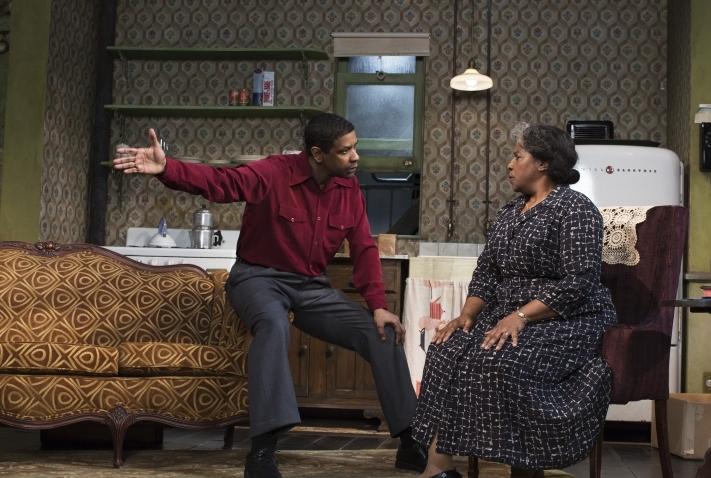
WALTER LEE & MAMA: Denzel Washington & LaTanya Richardson Jackson in ‘A Raisin in
the Sun.’ Photo: Brigitte Lacombe
Five Tony Nominations, including: Best Drama Revival; Best Drama Director, Kenny Leon; Best Actress in a Drama, LaTanya Richardson; Best Supporting Actresses in a Drama, Sophie Okonedo; and Anika Noni Rose.
Edited by Scott Harrah
Published April 5, 2014
Reviewed at press performance on April 4, 2014
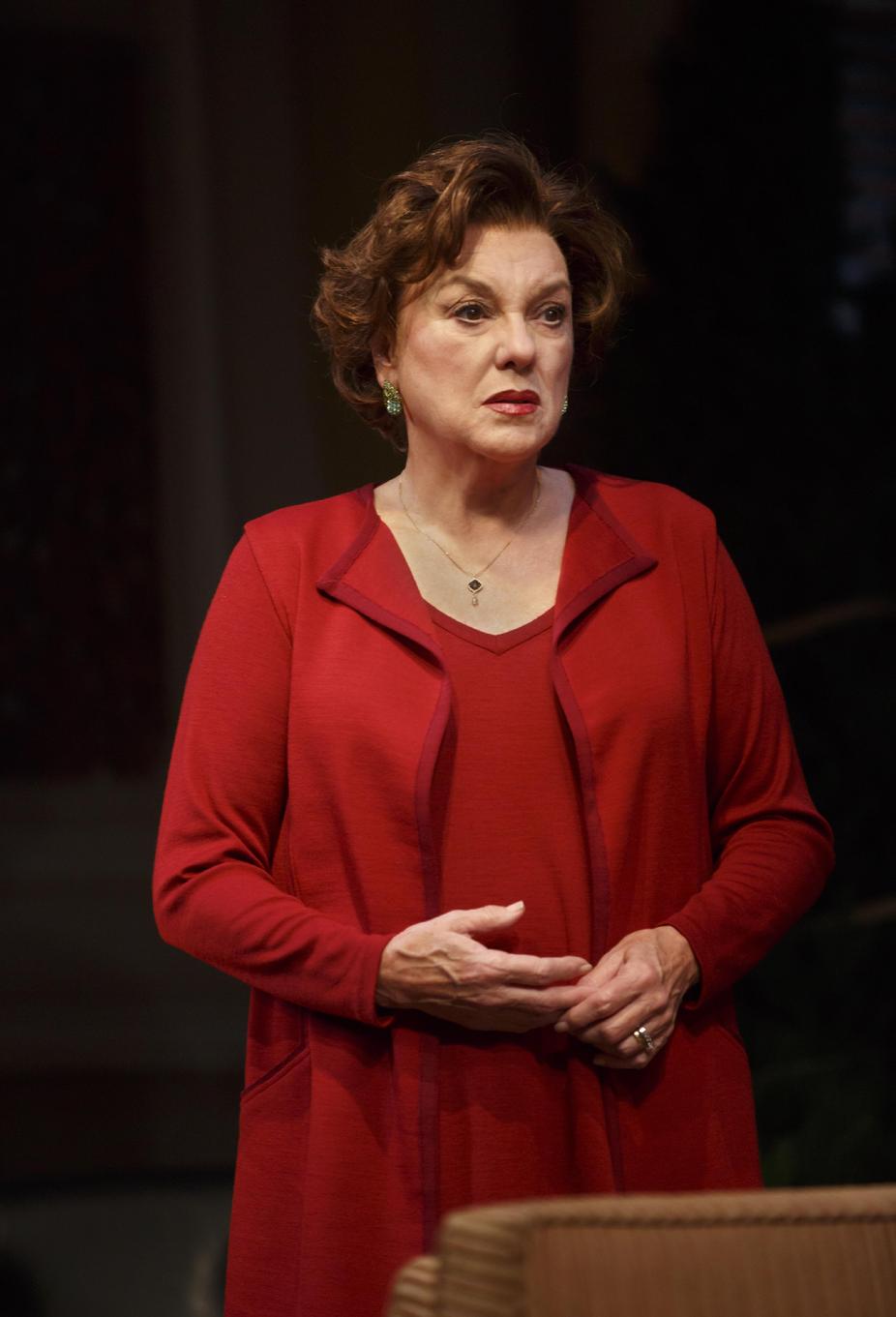
UNSYMPATHETIC CHARACTER: Tyne Daly as Katharine. Photo: Joan Marcus
[printfriendly]
[yasr_overall_rating]
MOTHERS AND SONS
By Terrence McNally
Directed by Sheryl Kaller
John Golden Theatre
252 West 45th Street
(212-239-6200), www.MothersAndSonsBroadway.com
By David NouNou
Set in a spacious, comfy Upper West Side apartment, we learn soon enough that Terrence McNally’s new play Mothers and Sons (a sequel to his 1990 PBS TV drama Andre’s Mother) will turn into a battleground. Everything from past and present, mothers and sons, denial vs. reality love vs. hate, closure vs. open wounds, fidelity vs. promiscuity, lovers vs. husbands, couple vs. family, are all headed for a collision course.
Katharine Gerard (Tyne Daly) has unexpectedly shown up at Cal Porter’s (Frederick Weller) apartment for no apparent reason. For what ex mother-in-law shows up at her dead son’s lover’s new apartment 20 years after his death? The talk is about Andre; the dead son. This premise reeks with touches of Vi and Sebastian Venable from Suddenly Last Summer. Andre died of AIDS and Cal was there for him till the last minute, Katharine never was, because she had issues. This sets the conflict in motion. To add to the mix, Cal has been married to Will Ogden (Bobby Steggert) for the last 11 years and they have a biological six-year-old son, Bud Ogden-Porter (Grayson Taylor). Cal, Will and Bud live the idyllic, gay married family life with nary a problem.
Well, at least till Katherine shows up, for she is the past, mother, in denial, hater, openly wounded, currently widowed and all alone. Cal is blissfully married with a husband and son, has closure, moved on, enjoys total fidelity with the new marriage laws, something that was denied to he and Andre when they were together back in the 80s, and is a living saint. If only it was that easy to meet a saint like that online? No spoiler alert, but that’s how Cal and Will met, the modern way. All the points that Mr. McNally makes are valid and make a strong case for people living in the past vs. the people who have moved on and are living in the present, but the premise is totally unbelievable. For who would ever let a mean-spirited, ex mother-in-law stay as long as she does and risk upsetting this Utopian lifestyle that is currently enjoyed by Cal and Will?
The characters as written have their hurdles to cross. Tyne Daly delivers the goods as Katharine, the mother-in-law from hell and spews every venom-filled line with gusto. Frederick Weller is saddled with a martyred character that is difficult even for a real saint to pull off. Grayson Taylor comes across as a cloying child actor that makes one yearn for any one of the kids in “The Partridge Family.” Bobby Steggert as the stay-at-home dad/writer has the balls to speak his mind and has the best line in the play; about AIDS in the 80s and all the victims it claimed all too soon will sadly be only a footnote in the future.
In this case, unfortunately and very sadly for all of us who remember those horrific times, it has already become a footnote. Had Mr. McNally written this play in the 90s, it would have been a strong and provocative play, but like all the plays that were written about AIDS in the 80s and 90s, they have already and very sadly become dated and a footnote. I wonder how many of the millennials actually know what the horrors and ravages of AIDS actually were? Alas, again only a footnote.
Nominated for 2 Tony Nominations: Best Play and Best Dramatic Actress, Tyne Daly
Edited by Scott Harrah
Published March 27, 2014
Reviewed at press performance on March 26, 2014
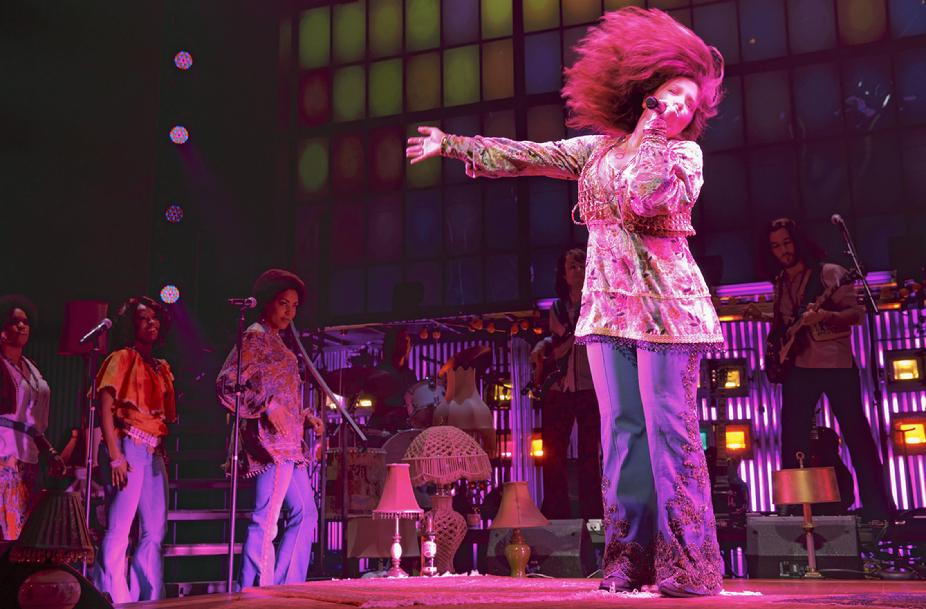
CHANNELING A SANITIZED JANIS JOPLIN: Mary Bridget Davies as Janis Joplin. Photo: Joan Marcus
[printfriendly]
[yasr_overall_rating]
A NIGHT WITH JANIS JOPLIN
Written and directed by Randy Johnson
Lyceum Theatre
149 West 45th Street
866-668-7285, http://anightwithjanisjoplin.com/
By Scott Harrah
There’s quite a story to tell about the late Janis Joplin, so it is frustrating indeed for anyone familiar with her to sit through the messy mash-up writer-director Randy Johnson has assembled here, with the outstanding Mary Bridget Davies bringing the tragic star back to life.
We watch and listen to a confusing array of the African-American female singers who influenced Ms. Joplin (Etta James, Odetta, Bessie Smith), interspersed with awkward, expository dialogue about the star’s down-home girlhood in Port Arthur, Texas, told while she sits in a chair and sips Southern Comfort. Much of the show covers “the blues” and cameo appearances from purported “blues” singers. Other than Bessie Smith, Odetta and The Chantels weren’t truly “blues” artists. In fact, it takes nearly 40 minutes of silly chatter in act one about “the blues” (from both Ms. Davies and the talented women playing the star’s heroines) before we hear a genuine Joplin classic, “Piece of My Heart.” When Ms. Davies belts out the words, with her gravelly voice, she is more than a marvelous impersonator, but we feel none of the trademark Joplin “soul.” Why? We are so bludgeoned by Randy Johnson’s scattershot narrative at this point that we don’t know what we’re seeing. Is it a musical biography? Or is it a tribute concert of people impersonating soul singers, with Ms. Davies channeling Janis Joplin as the headliner?
This overstuffed show might have the makings of a fun 90-minute nostalgia fest in a small theater in the East Village, but as is, in two long acts, this doesn’t belong on Broadway. Other than her infamous cussing, Ms. Joplin’s tale has been so sanitized that it seems more like a bio-musical of Doris Day than a woman known for indulging in sex, drugs, and rock and roll. So much needs to be cut here, from pointless tales of Joplin going to the library as a kid, idolizing Hemingway and Fitzgerald, to imagining Nina Simone (played with panache by De’Adre Aziza), popping up in her bedroom to sing “Little Girl Blue.” There’s a house-raising finale at the end of act one, featuring Aretha Franklin (Allison Blackwell), Ms. Joplin and the “Joplinaires” singing “Spirit in the Dark,” but it’s unnecessary and says nothing. Why feature Aretha jamming with Janis when there were real-life highlights of the icon’s career, such as her appearances at the Monterrey Pop Festival and Woodstock? Or her famous interview on “The Dick Cavett Show” in 1970, months before her death?
Act two gives us some bona fide Joplin standards, from “Try Just a Little Bit Harder” to a spine-tingling, raw rendition of “Cry Baby.” When Ms. Davies sings these classics, and the star’s only Number One hit, “Me and Bobby McGee,” one wonders why writer-director Randy Johnson chose to focus on so many numbers from legends that inspired Ms. Joplin, instead of just giving fans a shorter show that features her greatest original work. Ms. Joplin began performing in 1962, overdosed on heroin at age 27, and only had four years of major success, from 1966 to her death in 1970. A Night with Janis Joplin would work with much-needed trimming of all the filler. Janis Joplin, in her short life, inspired (and some argue, defined) an entire generation, but she lived hard and fast, and her inimitable spirit has been captured far better in countless biographies, the 1974 documentary Janis, and even The Rose (which was loosely based on Ms. Joplin), starring Bette Midler.
“Freedom’s just another word for nothing left to lose,” Janis Joplin once sang. Perhaps writer-director Randy Johnson took this notion too literally, for the liberties he takes with the material here are perplexing and never capture the essence of the real Janis Joplin. She was a talented and complex woman indeed (not some psychedelic Pollyanna), and deserves a more honest stage homage than this.
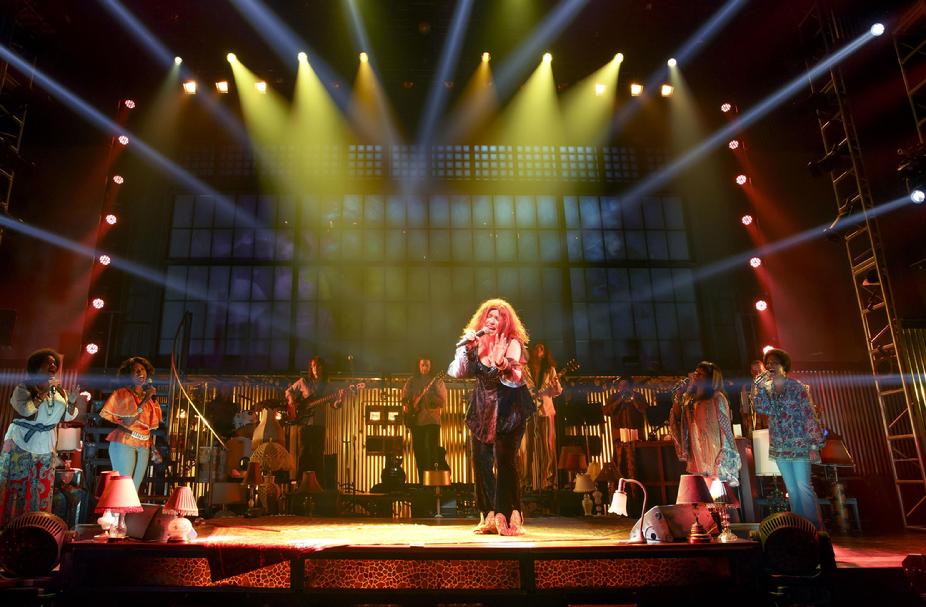
A LITTLE PIECE OF HER ART: Mary Bridget Davies as Janis Joplin in ‘A Night with Janis Joplin.’ Photo: Joan Marcus
Tony Nominated for Best Musical Actress Mary Bridget Davies
Edited by Scott Harrah
Published October 17, 2013
Reviewed at press performance on October 16, 2013